
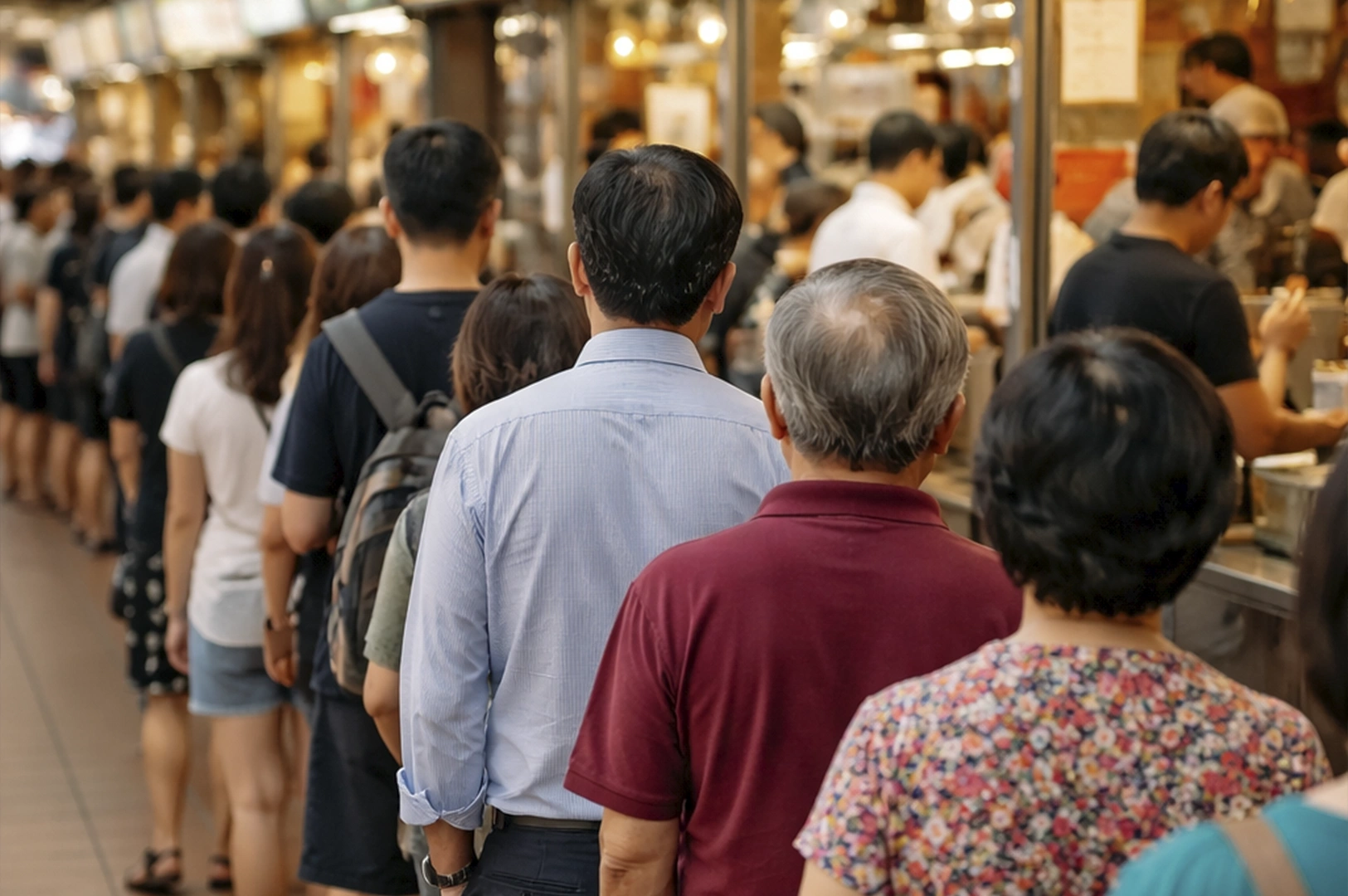
In Singapore, queues are not just about popularity. They are about belief.
You stand in line not because something is trending, but because you trust that what is at the end of it will deliver exactly what you expect. Not better. Not worse. Just the same satisfaction you remember.
That predictability is powerful.
In many cities, food evolves constantly to stay relevant. Menus change. Concepts pivot. But in Singapore, some of the most respected stalls have barely altered their recipes in decades. This is not a lack of innovation. It is a deliberate commitment to consistency over novelty.
Queues form around that promise.
There is also a psychological element. When you see a long queue, it signals validation. But in Singapore, it goes deeper than social proof. It reflects a shared understanding that good food is worth waiting for, especially when it has proven itself over time.
This behaviour is reinforced culturally. Growing up here means learning patience in food spaces. Waiting for your turn. Watching the preparation. Observing the rhythm of the stall. The queue becomes part of the experience, not just a barrier to it.
Interestingly, studies like those discussed by highlight how perceived value increases with wait time. But Singaporeans do not need studies to validate this. It is instinctive.
There is also a subtle social dynamic. Queues flatten hierarchy. Everyone waits. Office workers, students, tourists, retirees. In that moment, status dissolves. What matters is simply being next in line.
Yet, not all queues are equal.
Some are driven by hype. Social media, viral trends, limited-time menus. These queues feel different. Faster-moving, more impatient, less grounded. They fade quickly once the novelty wears off.
The enduring queues are quieter. Less performative. Often found in older neighbourhoods, tucked into corners that have not changed much.
What keeps them alive is not marketing. It is memory.
People return because the taste anchors them. A bowl of noodles that tastes like it did ten years ago. A plate of rice that reminds them of childhood lunches. These are not dramatic experiences. They are familiar comforts.
And in a fast-moving city, familiarity becomes a luxury.
So the next time you see a long queue in Singapore, it is worth asking. Is it hype, or is it heritage?
More often than not, it is the latter.Internal Link Recommendation:
For a deeper look into this behaviour, read: Singapore Food Queue Culture